Work coordination platform
Designed for the automotive industry
As a leader in innovation, you understand the importance of staying ahead of the curve in the fast-moving automotive 4.0 world. KanBo provides you with the tools to do just that by facilitating smart factory operations, streamlining project management, fostering collaboration and solving complex problems.
Streamlining Cross-Departmental Communication in Software Development with Team Leader Software
Introduction: KanBo, a work coordination platform, is designed to provide seamless communication and coordination across all departments and external stakeholders of large enterprises. Its unique features cater to the extensive range of needs and preferences of businesses across various verticals, including the automotive industry.
Feature Benefits: KanBo offers a wide range of benefits for large enterprises, including efficient project management, enhanced collaboration, and streamlined workflow. Its real-time updates enable teams to stay up-to-date with the latest project developments, facilitating timely decision-making and resolving issues as they arise.
Short Product Tour: The KanBo platform comes equipped with a range of innovative features designed to streamline work coordination in large enterprises. One such feature is its intuitive interface that enables users to easily access information and communication channels. Additionally, KanBo employs a range of tools such as automated workflows, task assignments, and notifications to keep teams informed and engaged at all stages of the project lifecycle.
Cross Departmental Communication in Automotive: The automotive industry, in particular, can benefit greatly from KanBo’s cross-departmental communication tools. With its real-time communication features, KanBo enables teams to collaborate seamlessly on complex and time-sensitive projects. Tight collaboration between teams working on different components of a vehicle can result in faster time-to-market, better product quality, and improved customer satisfaction.
Conclusion: In conclusion, KanBo is a powerful work coordination platform designed for large enterprises, and its innovative features provide efficient project management, enhanced collaboration and streamlined workflows. Its cross-departmental communication tools are particularly useful for the fast-moving automotive industry to ensure effective communication between teams working on complex projects.
If you are a team leader in the software development department of the automotive industry, incorporating KanBo into your daily workflow can be a game-changer. Here is a week in the life of a team leader using KanBo to help streamline and coordinate work in the automotive industry.
Monday: Start the week by creating a new workspace in KanBo for your team. Use the workspace to assign and delegate tasks to members of your team according to their strengths and expertise.
Tuesday: Use KanBo Spaces to store all project-related documents. You can easily access documents related to a specific project without having to search for them in various locations. You can even collaborate with other team members to make changes and progress updates directly within the document.
Wednesday: Take advantage of the KanBo Cards feature to break down larger tasks into smaller, more manageable units. Assign team members to specific cards, schedule due dates, and keep track of progress using card elements like notes, checklists, and card blockers.
Thursday: Use Kanbo’s Activity Streams and Notifications to stay up to date with the progress of different team members and projects. You can also use @Mentions to alert specific team members when they need to provide input or complete a task.
Friday: End the week by creating a report that summarizes the team’s progress over the past five days. Dashboards, Reports, and Resource Management tools in KanBo allow you to easily track progress, identify areas for improvement, and assess the overall success of the week’s projects.
By following this work routine using KanBo, you can streamline complex tasks, increase the productivity of your team, and stay ahead of the curve in the fast-moving automotive industry. With KanBo, team leaders in the automotive industry can lead with confidence and agility in today’s highly competitive market.
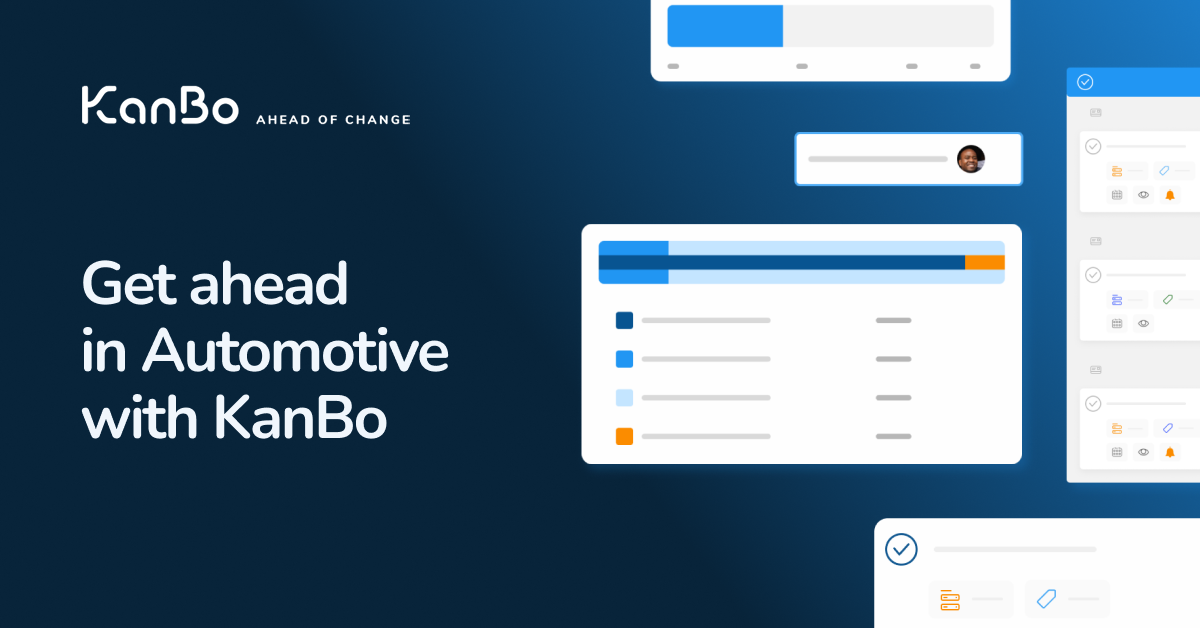
KanBo is much more than just a tool for cross-departmental communication. It is an integrated platform that is designed to streamline work coordination, simplify workflows, and foster collaboration across teams and departments. KanBo offers a range of features that go beyond just communication, such as document sharing, task management, and project tracking. With KanBo, you can easily visualize work, prioritize tasks, and keep everyone on the same page.
One of the unique strengths of KanBo is its ability to adapt to different workstyles and methodologies. Whether you use agile, waterfall, or hybrid approaches, KanBo can help you optimize your work management processes. KanBo offers a range of views, from Kanban and Gantt charts to Timelines and Dashboards, to help you visualize and manage your work in a way that suits your needs.
KanBo is also designed to support different types of businesses, from small startups to large enterprises. Whether you run a small team or a complex organization, KanBo can help you optimize your work processes and achieve your goals. With flexible deployment options, including on-premises and cloud installations, KanBo is designed to cater to the needs and preferences of every type of business.
In summary, while KanBo is a powerful tool for cross-departmental communication, its capabilities go far beyond just that. With its range of features and adaptability, KanBo is a versatile platform that can help you optimize your work coordination and achieve success across teams and departments.
Q&A
QA 1: What are the benefits of using KanBo for large enterprises in the automotive industry?
Answer: KanBo offers numerous benefits for large enterprises in the automotive industry. Some of these benefits include efficient project management, enhanced collaboration, streamlined workflows, and real-time updates that enable teams to stay up-to-date with project developments and resolve issues as they arise. With KanBo’s innovative features, teams can communicate seamlessly and collaborate on time-sensitive tasks to drive faster time-to-market, better product quality, and improved customer satisfaction.
QA 2: How can team leaders use KanBo in the automotive industry to streamline their workflow and coordinate work more efficiently?
Answer: Team leaders in the automotive industry can use KanBo to create workspaces, store project-related documents, break down larger tasks into smaller, more manageable units, and track progress across different projects and team members. With KanBo’s Activity Streams and Notifications, team leaders can stay up-to-date with the latest progress updates, assign and delegate tasks, collaborate with other team members, and assess the overall success of the week’s projects using reports and dashboards.
QA 3: What makes KanBo unique compared to other coordination platforms in the market?
Answer: KanBo is unique compared to other coordination platforms in the market due to its cross-departmental communication tools, intuitive interface, and a range of innovative features designed to streamline work coordination in large enterprises. With KanBo, teams can collaborate seamlessly on complex and time-sensitive projects, resulting in faster time-to-market, better product quality, and improved customer satisfaction. Additionally, KanBo offers automated workflows, task assignments, real-time updates, and notifications that keep teams informed and engaged at all stages of the project lifecycle.
Use Case: Creating an Agile Production Development Team for Autonomous Driving with KanBo
Imagine you are an executive in the automotive industry tasked with building and leading an agile production development team for algorithms and software in the area of assisted/autonomous driving with a focus on environment and scene understanding. This is a complex and multifaceted task that requires coordination across multiple departments and stakeholders.
To streamline the communication and collaboration across these teams, you decide to implement KanBo as your work coordination platform. With its intuitive interface and innovative features, KanBo allows you to efficiently manage projects and enhance collaboration across your diverse team of experts.
One of the challenges of building an agile production development team is coordinating the efforts of a diverse group of experts across different disciplines and skill sets. With KanBo’s cross-departmental communication tools, you can easily facilitate communication and collaboration between teams working on different components of a vehicle.
For instance, the World Model team may need to work closely with the Environment Fusion and Path Perception teams, who may be using different techniques and algorithms to achieve similar objectives. With KanBo, you can create shared boards that enable these teams to stay informed about each other’s progress, collaborate on complex problems, and rapidly iterate on solutions.
Moreover, KanBo’s personal board view feature enables each team member to customize their board view according to their individual preferences and workflow. Users can use Microsoft Office skills to filter and group cards, adjust display settings, collapse lists or add and remove columns in table view. By doing so, each team member can focus on the tasks that matter most to them, improving their productivity and reducing the risk of errors.
In conclusion, KanBo is a versatile work coordination platform that can help in building and leading agile production development teams in the field of autonomous driving. Its innovative features enable cross-departmental communication and collaboration, as well as customization of individual views to cater to the needs and preferences of each team member. By using KanBo, you can streamline your workflow, optimize your work processes, and achieve success across teams and departments.